

Electrodialysis
Posted on July 28, 2026 Physical Modeling

Electrodialysis (ED) is an electrochemical membrane-based process which has been adopted in a variety of applications such as water treatment, bioprocessing, pharmaceuticals and food industries. This process relies on the application of an electric current to promote the migration of ionic species from diluate channels into concentrate channels, thanks to a series of alternating Ion Exchange Membranes (IEMs), following the scheme presented in Figure 1. The primary product can either be the diluate or the concentrate stream, depending on the application.
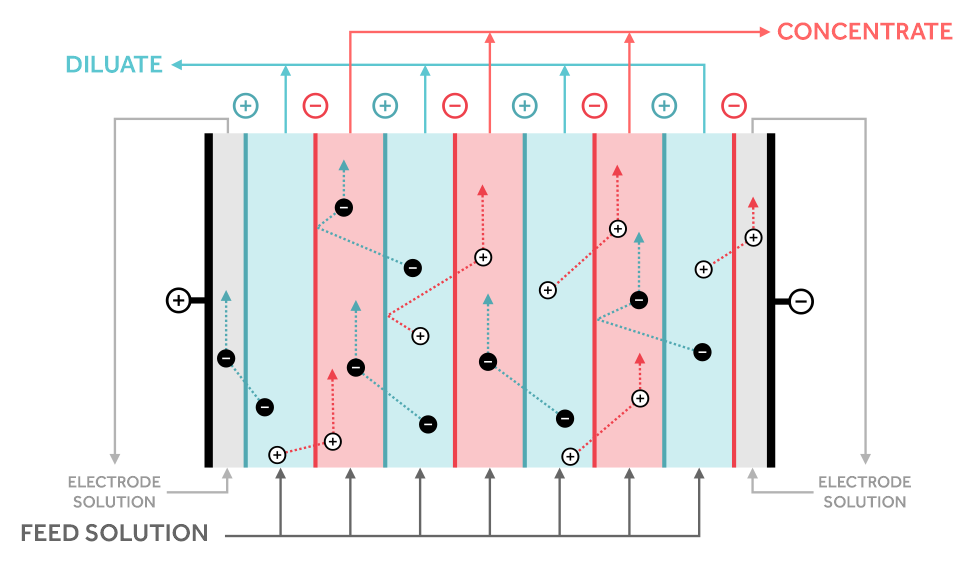
Figure 1. Schematic illustration of an ED process.
Typical ED stacks comprise tens to hundreds repeating cell pairs, where each cell pair consists of two membranes (one Cation Exchange Membrane, ‘CEM’, and one Anion Exchange Membrane. ‘AEM’), one diluate channel and one concentrate channel. In its basic configuration, the ED process has the feed solution flow co-currently in the diluate and the concentrate channels. The electronic current supplied at the electrode is transferred to an ionic current in the channels and the IEMs. The CEMs, negatively charged, pull cations through and repel anions. Conversely, the AEMs, positively charged, pull anions through and repel cations. Each diluate channel becomes depleted in ionic species as the ionic current pulls cations through the CEM on one side and anions through the AEM on the other side. Each concentrate channel collects the ions transferred from one diluate channel and blocks their transfer into the next one, since anions are repelled by the CEM and cations are repelled by the AEM. Neutral (uncharged) solutes would remain unaffected by the ionic current and not undergo transmembrane migration.
As the solution front progresses through the channels, the migration of ions across the channels becomes more difficult. First, the depletion of the ions in the diluate channels increase the resistance to the ionic current. Second, the increasing concentration difference between the two sides of each membranes gives rise to polarization effects, referred to as Donnan potential drops.
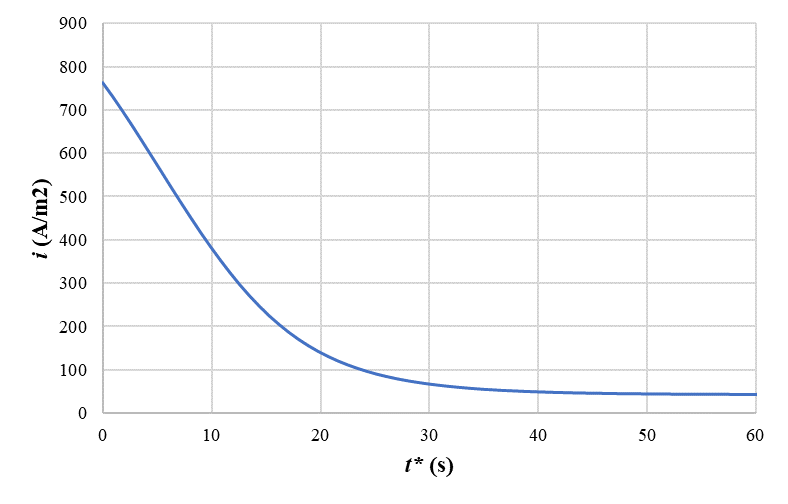
Figure 2. Ionic current density as a function of the residence time in the channels.
These two factors contribute to a decrease in ionic current with increasing residence time within the channels (Figure 2). Third, the current efficiency, which describes the ratio between transmembrane ion flux and the electronic current density, might decrease significantly in a situation of high salt removal: if the concentrate is much saltier than the diluate, ions are susceptible to leak from the concentrate back into the diluate (Figure 3).
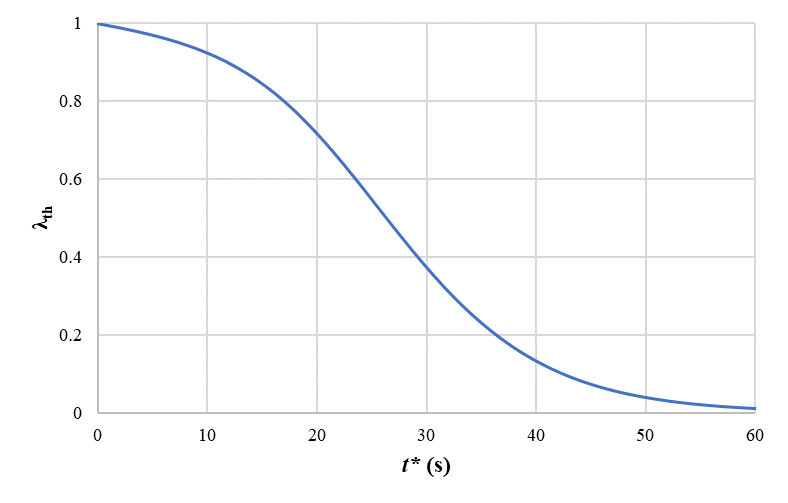
Figure 3. Current efficiency as a function of the residence time in the channels.
There can be a point where the applied electric current can only compensate for the diffusive driving force, and no further salt removal can be accomplished. These various inefficiencies can be assessed, which allows for an estimation of the concentration profiles in the channels as a function of the residence time (Figure 4).
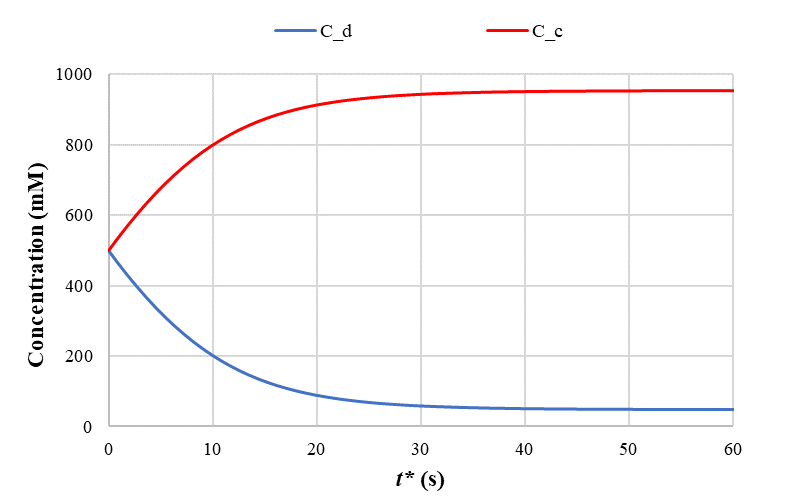
Figure 4. Concentration of the diluate and the concentrate streams as a function of the residence time in the channels.
The degree of salt removal in an ED process is easily tunable, and can be controlled by adjusting the voltage, stack configuration, residence time and membrane properties. Its modular nature also enables scaling from laboratory units to large‑scale plants. \
Overall, ED is a versatile, energy-efficient technology for enabling water treatment and ion separation processes.