

Centrifuge Modelling
Posted on June 3, 2026 Geotechnical Mathematical Modeling

Knowledge of how a material consolidates is important for many industries, including fine tailings management in a storage facility. Accurately predicting the mudline interface elevation over time influences many aspects of the operation such as water inventory, containment, water quality, and regulatory reporting. To make these predictions, it is necessary to understand the compressibility and permeability relationships of the consolidating material. Typically, these relationships are determined by complex and lengthy step-wise procedures such as large-strain consolidation (LSC) testing.
Recent Publication
We have recently published a paper [1] with Suncor Energy Inc. demonstrating a method for determining the consolidation properties of a material by analyzing continuous settlement data recorded using the desktop-sized geotechnical centrifuge developed by Coanda and Suncor [2] which is equipped with in-flight photography (the “PASS” centrifuge). Our method solves this inverse problem by iteratively solving the consolidation partial differential equation (PDE) numerically using custom Python code to find the optimized parameters that result in the best match with experimental data.
Materials such as tailings consolidate under self-weight and can settle substantially over time. The one-dimensional consolidation of this material is described using Gibson’s equation [3] [4] which can be modified to account for consolidation through centrifugation [5] [6]. The equation requires compressibility and permeability relationships for the material, which are often parameterized with power laws using a set of four parameters, the so-called ABCD parameters. A material’s consolidation behaviour can thus be described through its ABCD parameters.
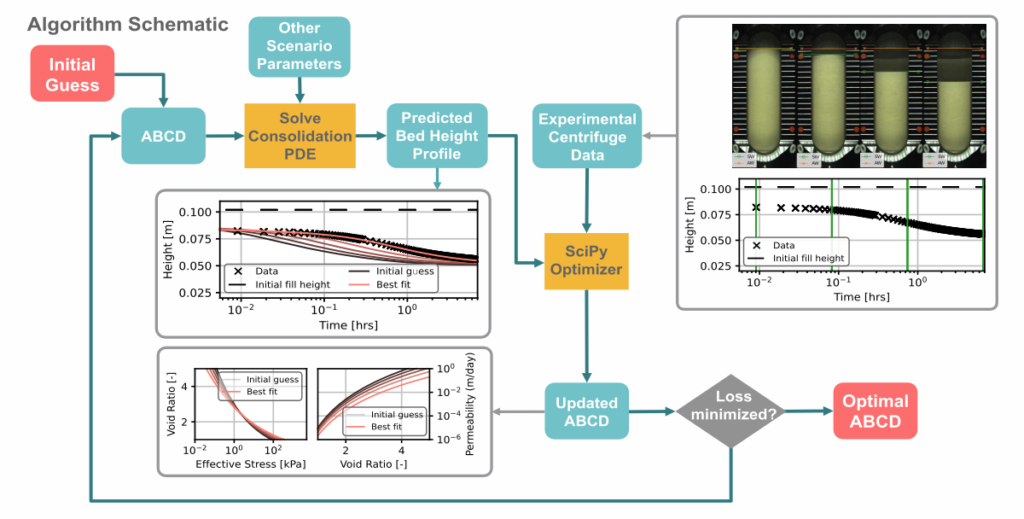
Figure 1: Flowchart describing the algorithm steps to find the ABCD parameters.
Method
Our method, shown in Figure 1, numerically determines the best ABCD parameters given experimental mudline height vs. time data collected from a consolidating column or the PASS centrifuge. First, we choose an initial guess for the ABCD parameters. Next, we numerically solve the governing partial differential equation for the consolidation scenario, yielding predicted interface heights at the same measurement times as the experimental data. The algorithm compares the predicted and actual height data using a loss function based on a Bayesian methodology. The consolidation parameters are updated and the process repeated to find a new loss function value. The algorithm iteratively refines the updates to the parameter values until the loss function is minimized and we have the best match between the predicted and experimental data. This method, in conjunction with the PASS centrifuge, can provide consolidation parameter estimates in around a single day, compared with the many weeks or months required for LSC testing.
To demonstrate our algorithm’s performance, we provide example comparisons with experimental data. First, we compare the results from our algorithm with those from an LSC measurement. Samples from the same material were characterized in an LSC test and then with our algorithm using height data from samples spun in the PASS centrifuge. The resulting compressibility and permeability curves from the two methods are similar, as shown in Figure 2, demonstrating that the material properties found from the two methods are consistent.
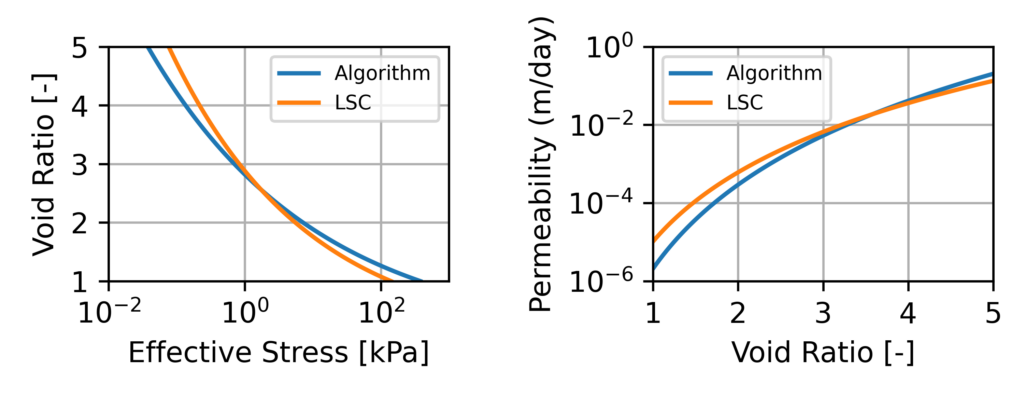
Figure 2: Compressibility and permeability relationships using the consolidation parameters found from LSC measurements and our algorithm.
The same material was deposited into three columns that were 0.5 m, 1.5 m, and 5 m tall. The solids interface height was monitored over the next 1-3 years. Both predictions using the LSC’s and our algorithm’s characterizations of the ABCD parameters provide a reasonable match the column data (Figure 3).
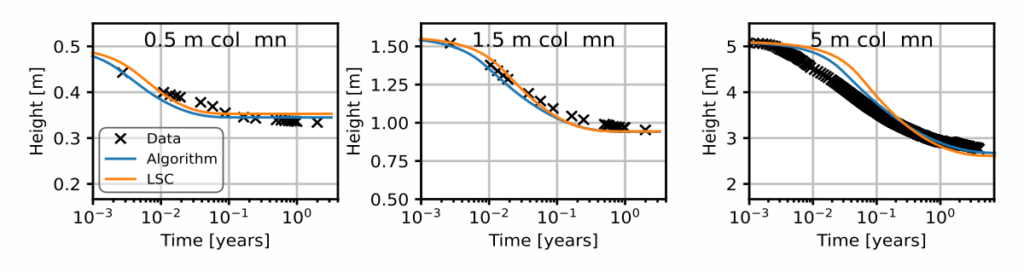
Figure 3: The interface settling data for three columns of different size (black crosses) and the predicted settling curves using consolidation parameters retrieved from LSC measurements (orange) and our algorithm (blue).
An example application is in layered deposits. Here, we use data from 1.5 m consolidation columns comprised of three layers from different materials X, Y, and Z. The materials were deposited in three equal layers to make two columns, one layered X-Y-X and one layered Z-Y-Z. The Y and Z materials consolidate rapidly; the X material is slow to consolidate. For each material, we use our algorithm to determine the consolidation parameters, using data from PASS centrifuge spins where each material was spun individually. Using the ABCD parameters for each material determined by our algorithm, we simulate the 1.5 m layered deposit using the commercial FSCA (Bright Beacon Co. Ltd.) consolidation simulation software.
We collected both height and density data from the 1.5 m columns over the course of a year. The column density was measured as a function of height by traversing a gamma-ray densitometer along the column. The simulated and measured density data, shown in Figure 4, show step changes in density that indicate a different layer of material. The absolute density values obtained from the simulations are similar to the measured data, indicating that the consolidation properties from our method can be used to predict outcomes beyond just overall interface height.
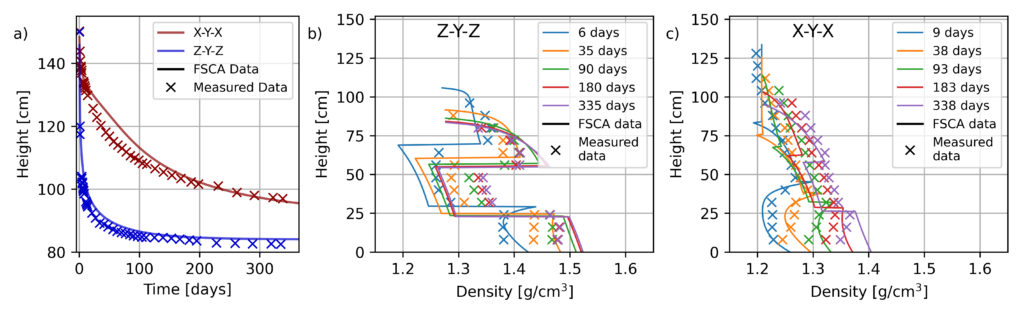
Figure 4: Measured a) water / tailings interface and b), c) density data (crosses) for two columns comprised of layered materials. Simulated data from the FSCA software is shown for comparison (solid lines), using the material properties determined by our algorithm.
When combined with the necessary centrifuge testing, this method can provide consolidation parameters in around a single day compared with many weeks or months for large strain consolidation testing. Only a few hundred millilitres of sample are required. While the method is not intended to replace traditional geotechnical methods, it could help to provide consolidation parameters for many more samples than are typically analyzed. This would improve understanding of material variability and improve confidence in tailings deposition plans.
References:
- [1] A. Rigby, M. Moeller, N. Dubash, A. Sorta, S. E. Webster and C. Amizola, “Efficient consolidation parameter estimation from continuous centrifuge interface data,” in Proceedings of Tailings and Mine Waste 2025, Banff, Canada, 2025. pp. 419-429
- [2] A. R. Sorta, N. Dubash, B. Moyls, S. E. Webster and O. Omotoso, “Development of a small-scale geotechnical centrifuge,” International Journal of Physical Modelling in Geotechnics, vol. 24, no. 4, pp. 189-201, 2024.
- [3] R. E. Gibson, G. L. England and M. J. L. Hussey, “The theory of one-dimensional consolidation of saturated clays,” Geotechnique, vol. 17, pp. 261-273, 1967.
- [4] R. E. Gibson, R. L. Schiffman and K. W. Cargill, “The theory of one-dimensional consolidation of saturated clays II. Finite nonlinear consolidation of thick homogeneous layers,” Can. Geotech. J., vol. 18, pp. 280-293, 1981.
- [5] P. J. Fox, J. Lee and T. Qiu, “Model for large strain consolidation by centrifuge,” International Journal of Geomechanics, vol. 5, no. 4, pp. 267-275, 2005.
- [6] X. Zhao and W. Gong, “Numerical solution of nonlinear large strain consolidation based on non-Darcian flow,” Mathematical Problems in Engineering, vol. 2019, 2019.